Why Health Trends Matter More Than Single Readings
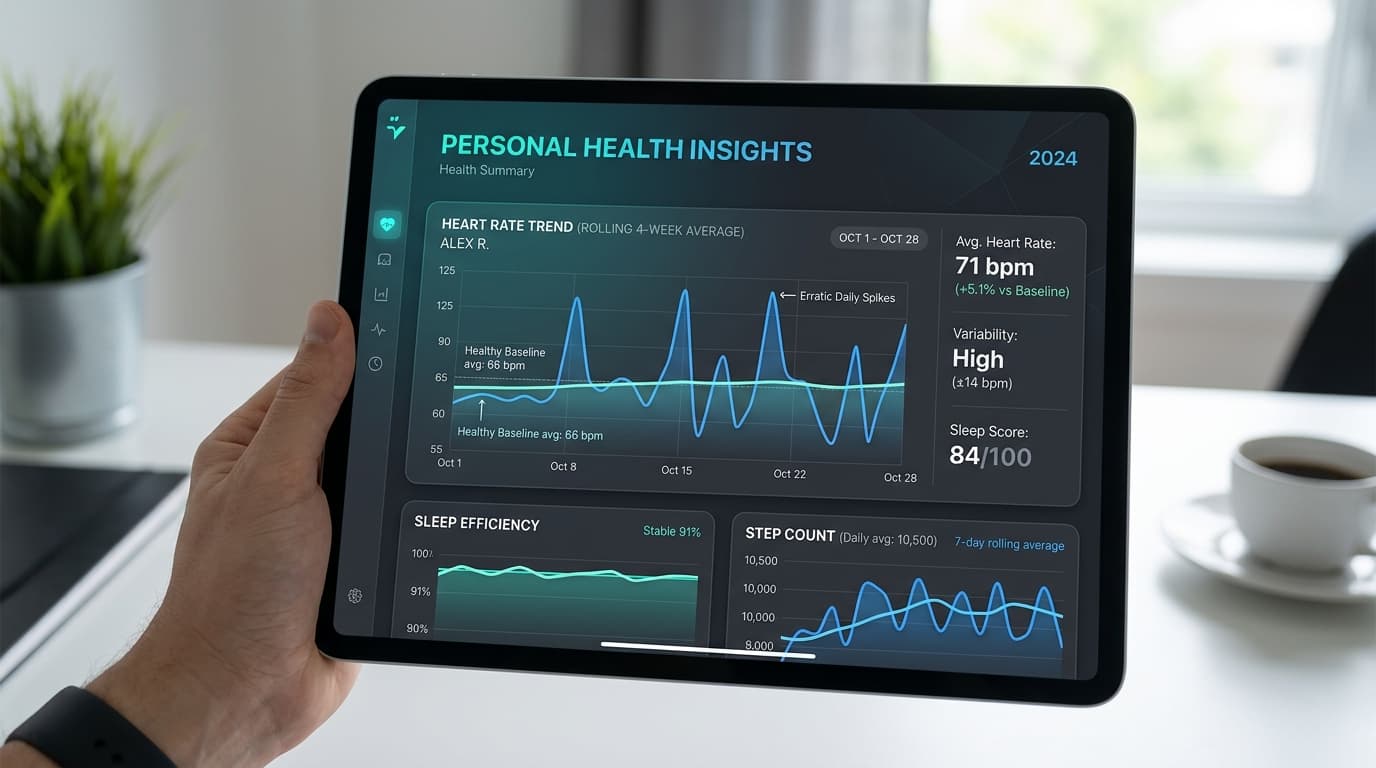
You sit down, strap on the blood pressure cuff, press start, and watch the digital display read 148/92 mmHg. Your heart sinks. You begin to worry: *Is my medication failing? Am I on the verge of a hypertensive crisis?*
Before you let anxiety spiral, take a deep breath. In modern clinical medicine, an isolated reading is almost completely meaningless.
Your body is a dynamic living organism, not a stationary machine. A single reading is a snapshot taken at a single millisecond in time, while true health is an ongoing motion picture.
The Reality of Biological Noise
Every vital sign you measure is subject to constant physiological fluctuations:
- Blood pressure naturally surges when you have a full bladder, when you have walked up a flight of stairs five minutes prior, or when you are feeling anxious about the test itself.
- Blood glucose spikes not just from food, but from a surge of morning cortisol (the dawn phenomenon), dehydration, or a poor night's sleep.
- Body weight can bounce by 1 to 2.5 kilograms in a 24-hour window simply due to fluid balance and glycogen replenishment.
Reacting emotionally to single peaks and valleys leads to "health monitoring fatigue" and unnecessary stress—which ironically raises your blood pressure and glucose even further.
How Clinicians Evaluate Trends
When an experienced physician reviews your records, they scan for longitudinal trajectories rather than single outliers:
1. Rolling 7-Day and 14-Day Averages
By averaging your readings over a weekly cycle, the extreme outliers balance out. If your average is comfortably within target range, an occasional Tuesday spike is usually nothing more than normal biological variance.
2. Directional Velocity
Is your weekly average steadily climbing week after week, remaining completely flat, or drifting down? The direction and velocity of change tell us whether a therapeutic intervention or dietary shift is working.
3. Diurnal Circadian Patterns
Do your readings follow healthy biological rhythms? For instance, healthy blood pressure dips 10% to 20% at night during sleep. If readings remain stubborn around the clock, that pattern provides vital diagnostic insight.
Clinical Advice: Never judge your health by today's worst reading. Look at your 14-day trend line—that is where your true physical story lives.