Tracking Education 5 min read
How Often Should You Track Weight?
LuckyMedico Nutrition & Wellness TeamMedical Expert
January 8, 2026
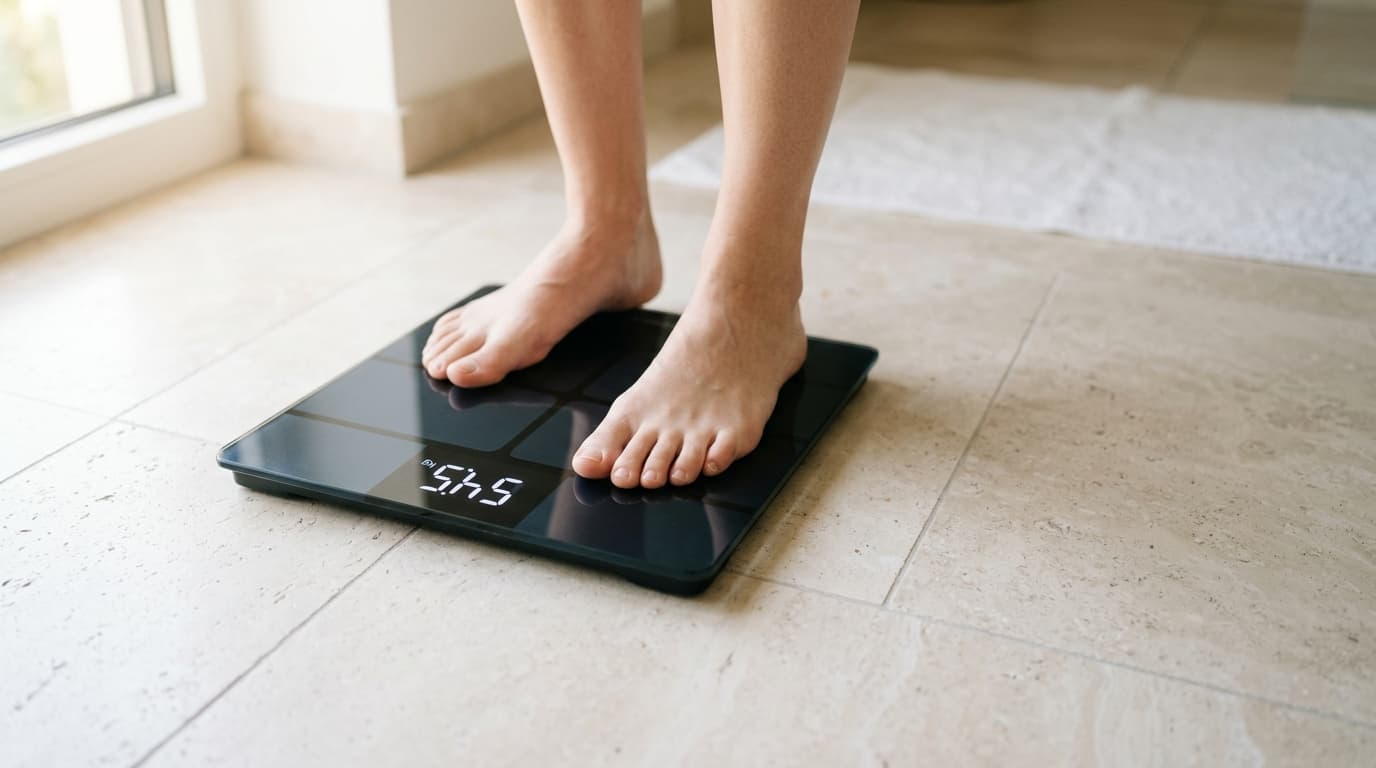
Step onto the bathroom scale on Monday morning, and it says 74.2 kg. Step onto it Tuesday morning after a rigorous workout and a clean dinner, and it suddenly says 75.6 kg. How is it possible to gain nearly 1.5 kilograms of fat overnight while eating healthy?
It isn't. You did not gain fat. You gained water.
Understanding how and when to track your body weight is the difference between staying motivated on a lifelong wellness journey or falling into a spiral of scale-induced anxiety.
The Science of Daily Scale Fluctuations
True changes in adipose tissue (body fat) or skeletal muscle mass occur slowly over weeks and months. When your scale bounces dramatically from one day to the next, it is almost exclusively reflecting:
- Sodium and fluid retention: A single sodium-rich restaurant meal can cause your body to hold up to two liters of extra water (equivalent to 2 kg on the scale) to maintain osmotic balance.
- Muscle glycogen repletion: Every gram of stored glycogen in your liver and muscle tissue binds roughly three to four grams of water.
- Digestive tract contents: Food passing through your GI tract has mass.
- Hormonal shifts: In women, the luteal phase of the menstrual cycle frequently causes 1 to 3 kg of cyclical fluid retention.
Daily Weighing: Who It Helps (and Who It Harms)
Daily Weighing is Ideal For:
- People who understand biological variance and view the scale as a dispassionate data point.
- Those who calculate weekly rolling averages. (If your daily numbers are 75, 76, 74.5, 75.2, 74.8, your weekly average reveals the true trend).
- Clinical research consistently shows that daily weighers maintain long-term weight loss better because they catch lifestyle drift early.
Weekly Weighing is Better For:
- Anyone who feels emotional distress, shame, or anxiety when the scale fluctuates.
- Individuals with a history of disordered eating or obsessive calorie counting.
- Those who prefer to focus on non-scale victories like waist circumference, energy levels, and strength gains.
The Optimal Weighing Protocol
If you weigh yourself, standardize the conditions completely:
- First thing in the morning: After using the bathroom, before drinking water or eating breakfast.
- Minimal clothing: Unclothed or wearing identical light sleepwear.
- Hard, flat surface: Never place a digital scale on carpet or uneven bathroom tiles.
Takeaway: The scale measures your relationship with gravity, not your self-worth. Choose the tracking cadence that keeps you calm, consistent, and moving forward.
Share this article: